|
|
The importance of 'student voice'
There is a strongly emerging literature and many examples in practice that have drawn attention to the importance of young people's 'voice' or (more broadly) 'participation', in building engagement in and with schools. We can draw particular attention to:
- the UK ESRC Consulting Pupils About Teaching and Learning Project (http://www.consultingpupils.co.uk/) based at Cambridge University, which has drawn together resources, stories and research;
- the work around Students as Researchers in the UK (Fielding and Bragg, 2003) and Australia (Edwards and Hattam, 1997; Edwards, 1999, 2000); and
- initiatives outside education (NSW Commission for Children and Young People, 2001, 2005; Youth Affairs Council of Victoria, 2004) for examples and initiatives in 'consulting with young people' to improve practice.
However, these studies and initiatives are not without their own controversies. For example, Comber (2003) points to the importance of 'different voices' being heard, and Mitra (2004), along with others, recognises difficulties in assessing 'student voices' when these are selected, analysed and interpreted by others.
However, these studies point to the voices of young people as being powerful in improving our understanding of what is needed for young people's engagement with school (ie they focus on the value of consultation with young people).
Other studies have gone further to point to the importance of linking 'voice' to 'action' (eg Fielding, 2001; Field et al, 2002; Holdsworth, 2005a). They have seen the central issue of 'student voice' as not one of providing data for others to make decisions, but as integral to encouraging young people's active participation in shared decisions and consequent action about their own present and futures.
Therefore, these studies point to the voices of young people as being directly powerful in promoting and indicating active engagement in school (ie they focus on voice as a strategic component of changed pedagogies).
Towards a framework for 'student voice'
These initiatives and research have been located within an education, health and wellbeing framework that has emerged strongly and consistently over the last 15 years, and which defines and guides the construction of new roles for young people through schools.
For example, Walker and Kelly (2002) suggest that student motivation to learn (closely linked with engagement) depends on three key student needs:
- to feel in control of their learning (significant input to rules and procedures, establish learning goals and tasks, decide how to work);
- to feel competent (investigate and respond to issues of survival and quality of life, solve real problems, create real products); and
- to feel connected with others (cooperative and collaborative learning, peer support, community linkages, mutual respect).
Earlier, Newmann, Wehlage and Lamborn (1992) said that learners need to have a clear purpose, be valued and be treated with respect and fairness.
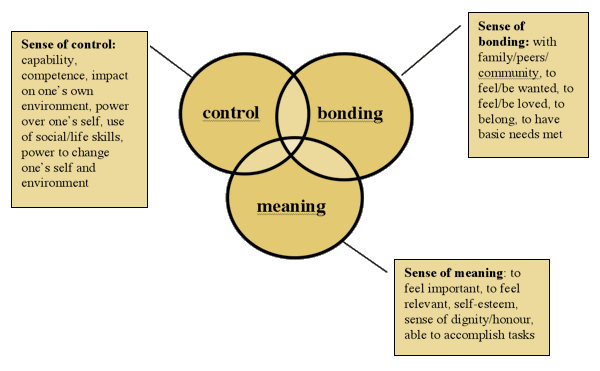
And similarly, Nancy Phillips in 1990, in summarising research about the development of strong self-concept in people, pointed to three central and inter-related factors:
Each of these statements or models points out that active participation in decision-making is vital within the development processes for us all - as individuals, and as a society. But they also point to the critical nature of working collaboratively with others (not alone or as isolated individuals) and, most importantly, of focusing on the content and application of the curriculum learning - on establishing publicly useful roles for young people that transcend simply listening to 'voices', 'views' or 'perspectives'.
Critical Questions 1:
As we embark on this work, it is important to ask ourselves:
- Why are we interested to encourage and hear the voices of young people? What are we going to do with what we hear?
The answers that we give to this question will shape what we hear, how we use that information, and what practices we establish.
|
|
|