|
|
Intention of this study
This discussion paper is presented in association with an Annotated Bibliography of recent studies that present the views of young people with high support needs in mental health, about engagement with school and education. The review of issues emerging from the literature is intended to lay a basis for the future development of appropriate resources for use by and within schools as part of MindMatters Plus. The form, content and extent of these resources will be developed within the project and while some may be able to be completed within this project; others may require further submissions for support and more extensive development.
Therefore, at this stage, this paper draws on the Annotated Bibliography to provide:
"A report that presents an analysis of themes emerging from those studies, including the implications of young people's perceptions for future mental health promotion in schools that is focused on students with high support needs in the area of mental health."
At various points through this paper, we pose specific questions that we hope are useful in focusing your thoughts and discussion about the issues being raised.
Approach to this study
In a short time, we located approximately 130-140 relevant and associated articles (and other documents) and carried out a careful scan of approximately 80 of these at this point, with a further 50-60 articles awaiting location, provision or summary for inclusion in the bibliography. They will be progressively added in, so that the on-line Annotated Bibliography will change from time to time.
These documents were found by searching available library databases and more broadly on the internet around criteria such as 'voice', 'views', 'perspectives' and 'student'; 'young people' and 'high support needs' and 'mental health'; various forms of 'youth/young people/student' and 'mental health/mental illness/psychosis/depression/anxiety/eating disorder'; 'youth/young people' and 'school/engagement/education'; and 'mental health' and 'school/education'. We also scanned related bibliographies and located many sources that looked interesting but might not otherwise have been found through strict application of search criteria.
There were some difficulties involved with defining (screen 4) these terms and this is discussed later in this document. We note here that the term 'high support needs' is, as yet, not widely used in the literature around young people experiencing mental health issues, and other linked and related terms were sought in our searches. (We should note that the term is intended to move away from a deficit approach to young people and towards a focus on the responsibility for provision of support. However there remains a strong tendency within much of this literature to adopt approaches that regard these young people as deficient in some way.)
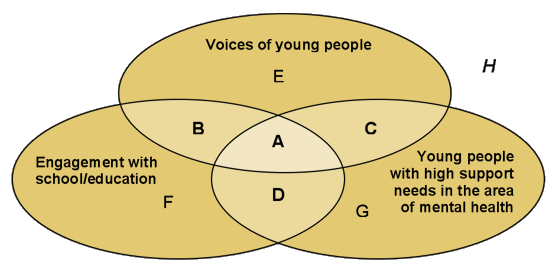
In the process of refining and carrying out these searches, and then in categorising the documents we found, we developed a Venn diagram (below) that we presented in the Annotated Bibliography. This provided a guide for us to structure what we were finding and to suggest further possible paths, and it also indicated the extent of existing studies and hence gaps identified in the literature.
Defining the field
In the Annotated Bibliography, we wrote:
"When we looked at this question, three separate domains of interest emerged, and these structured our searches for studies:
a) we are interested in studies that have documented the voices of young people - in preference to quantitative surveys or researcher discussion of issues (though see the note about this later in this introduction). We are therefore interested in active voice rather than voices inferred from responses to researcher questionnaires. We have found studies that provided 'voice' through many forms: art work as well as words for example, and these have been included. We also found many studies that commented on the importance of student voice, or that discussed methodological issues associated with voice; while these are strictly outside the immediate domain of interest, these are listed here separately.
b) we are interested in the voice of specific young people - those with high support needs in the area of mental health. We found many studies that reported the views of young people generally, but very few that were focused in this area, or that identified such young people specifically. However, we found studies that identified young people with disabilities, young people in care and, more generally, young people 'at risk'; though these studies are not strictly within the domain, we may learn something from the voices of young people with other high support needs, so these are also listed here.
c) we are interested in views on engagement with school/education. Educational studies may report young people's views on school engagement directly, but may also include a range of education, personal, family and social issues that have an impact on engagement; again, these are listed here.
We saw these three domains as interacting to define our searches and identified eight separate sections to organise this bibliography:
A: Studies that report the voices of young people - with high support needs in the area of mental health - about engagement with school/education: the central core of our study.
B: Studies that report the voices of young people generally - about engagement with school/education; this area can, in turn, be divided into studies that report related voices ('in care', 'disabled', 'at risk'), and those that are less specific; it can also include some advocacy studies about 'voice' that provide examples incidentally.
C: Studies that report the voices of young people with high support needs in the area of mental health - about non-school/engagement issues; again, some of these may be related in that the issues have implications for school engagement;
D: Studies that report on issues about the engagement with school/education - for young people with high support needs in the area of mental health - but without reporting what young people say.
E: Studies that report the voices of young people generally, but not on school engagement and not specifically identifying young people with high support needs in the area of mental health.
F: Studies about the engagement of young people generally with school/education, including some methodological studies on 'voice' in this area.
G: Studies about issues facing young people with high support needs in the area of mental health, not specifically education.
H: Other studies (only included for if some linkage to the above)."
|
|